
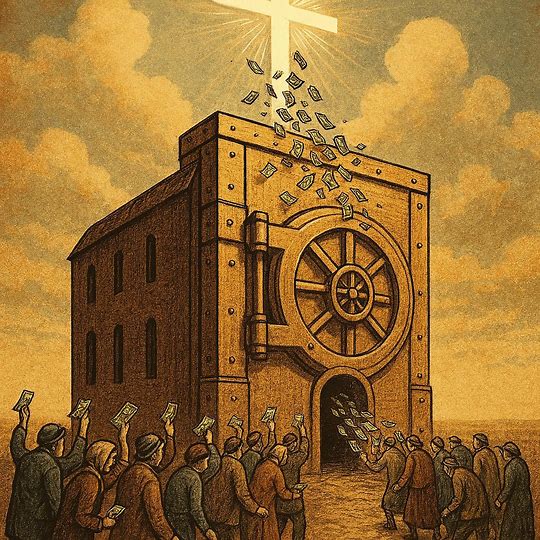
“Thank you for marching alongside us in faith—your visit today is a blessing!” Your presence here is a testimony to God’s guidance—thank you for being part of His work. We’re soldiers for His kingdom. Your visit is a reminder of God’s amazing grace! God bless you and yours!
Hello, Friends! Glad to have you here on this journey, it will answer in only the way it should, through the Words of our Father in Heaven. To expose the lying and manipulative way the church system has made “Tithing,” thievery in its modern day institutions. So buckle-up and get ready to learn how evil has disguised itself in God’s supposed Temples!
This is a very important subject matter—and it deserves a straight, Scripture-grounded answer without tradition layered on top of it. First; there is NO verse in the Bible that commands Christians to give 10% of their gross income to a local church. You will not find a single passage that says:
“Give 10% of your income to your local church.” That exact idea is not stated anywhere in Scripture. What the Bible actually says about tithing in the KJV is:
1. Tithing was part of the Old Covenant (Law of Moses) given to Israel—not the Church of the New Testament. The tithe was tied to Israel, land, and agricultural produce in (Leviticus 27:30). “And all the tithe of the land, whether of the seed of the land, or of the fruit of the tree, is the Lord’s…”
(Numbers 18:21); “And, behold, I have given the children of Levi all the tenth in Israel…” ‘Friends, the tithe Was 10% of produce and livestock, It went to the Levites (tribe of Levi). They supported the Temple system, not a modern church structure that’s like a 7/11 on every other corner to conveniently take your money.
2. There were actually multiple tithes, not just one 10%. Many are not told this. A festival tithe (eaten by the giver). Explained in; (Deuteronomy 14:22–23 KJV), “Thou shalt truly tithe all the increase of thy seed… And thou shalt eat before the Lord thy God…”
And a tithe for the poor (every third year said in; (Deuteronomy 14:28–29), the stranger, and the fatherless, and the widow… shall come, and shall eat and be satisfied…” When you total these out, Israel gave well over 10% in practice.
3. Tithing was never commanded to Gentiles, the Law (including tithing) was given to Israel—not to the nations. (Psalm 147:19–20); “He sheweth his word unto Jacob… He hath not dealt so with any nation…” What about the New Testament?
4. Jesus mentioned tithing—but under the Law, before the cross (Matthew 23:23). “…ye pay tithe of mint and anise and cummin… these ought ye to have done…” Friends, this is Important; Jesus was speaking to Pharisees still under the Law. This was before His sacrifice, before the New Covenant was established.
5. After the cross: Giving is not commanded as 10%. There is no command anywhere in the New Testament epistles that believers must tithe. Instead, giving becomes voluntary, Spirit-led, and from the heart. The true New Covenant principle is in (2 Corinthians 9:7);
“Every man according as he purposeth in his heart, so let him give; not grudgingly, or of necessity: for God loveth a cheerful giver.” Yet friends, take notice; “tithing,” is ‘Not required.’ Not a fixed percentage. Not under pressure (“necessity”).
6. Giving in the early Church was based on need—not percentage. (Acts 2:44–45); “…had all things common; And sold their possessions… and parted them to all men, as every man had need.” In (Acts 4:34–35) says; “…neither was there any among them that lacked…” This is radically different from; weekly 10% obligation systems, and institutionalized giving structures.
7. Believers are not under the Law. This is the key that changes everything. (Romans 6:14) says; “…ye are not under the law, but under grace.” (Galatians 3:24–25); “Wherefore the law was our schoolmaster…
But after that faith is come, we are no longer under a schoolmaster.”
If tithing is part of the Law, then It is not binding under the modern day Grace! So why do many churches teach 10% of gross today? Because of; Tradition carried over from Old Testament Israel. And outdated Institutional funding models. Along with “Misapplication of passages like (Malachi 3:10).” Which says;
“Bring ye all the tithes into the storehouse…” ‘Friends, understand This was “Spoken to Israel.” About Temple storehouses, and For Levites and the poor. Not a command to New Testament believers to fund modern churches. These could be the honest conclusion, but not yet. We must fully understand what our Father wants us to know!
There is no KJV verse commanding Christians to give 10% to a local church. Tithing was “Agricultural,” National (Israel), Levitical (Temple-based). The New Covenant teaches; Freewill giving, Cheerful giving, Spirit-led generosity, and Care for God’s people—not systems first.
A sobering truth is; The danger is not in giving. The danger is in turning giving into law again, when Christ fulfilled the Law. (Galatians 5:1); “Stand fast therefore in the liberty wherewith Christ hath made us free…”
‘Friends, lets go even deeper so there will be no room for misunderstanding and you will not be a victim of being taken again by what should have been the most trusted but yet the most vicious of abominations to Gods people! So lets carefully, and historically, be anchored in truth rather than any tradition for the rest of this teaching.
What you’re going to see is not a conspiracy in the shadows, but something more sobering: a slow shift—from Spirit-led generosity to structured obligation—as the Church moved from a persecuted body to an institutional power. The Apostolic Church (1st Century): No Tithe System.
In the time of the apostles. There is no record of a mandated 10% system. Giving was; “Voluntary, Need-based, Often sacrificial beyond percentages.” We already saw in (2 Corinthians 9:7); “…not grudgingly, or of necessity…” The Greek idea behind “necessity” implies compulsion, pressure, or imposed requirement.
The early Church operated on:
- Love.
- Shared burden.
- Immediate care for the poor.
- Not institutional funding quotas.
Early Church Fathers (100–300 AD): Still No Commanded Tithe. Writers like; Justin Martyr, Irenaeus, and Tertullian describe Christian giving. What did they say? Justin Martyr (c. 150 AD) described offerings; Believers gave “what each thought fit.” Tertullian (c. 200 AD) wrote Giving was voluntary, “not taken by compulsion.” Notice; there is no mention of a required 10% tithe.
Instead offerings were freewill, used for; Widows, Orphans, Prisoners, and the poor. The Turning Point: Constantine (4th Century). Everything begins to shift under Constantine the Great. What changed? Christianity becomes state-favored (313 AD) via the Edict of Milan.
The Edict of Milan was an important step in securing the civil rights of Christians throughout the Roman Empire. For nearly three hundred years, Christianity was functionally illegal in the Roman Empire. Christians were subject to various levels of persecution, up to and including arrest or execution, depending on the whims of the ruling politicians.
In 313, the Western emperor, Constantine, met with his rival and counterpart, the Eastern emperor, Licinius, in the city of Milan, Italy. As part of their discussions, they issued a joint statement, later known as the Edict of Milan. This proclamation protected full rights for Christian citizens of the Empire, restoring their property, releasing them from prisons, and effectively banning government persecution of their faith.
It also declared a general state of religious tolerance, allowing for the expression of virtually any spiritual belief. This is critical, Clergy begins to mirror Roman administrative systems. Once the Church gained: Buildings, Salaried clergy, Political influence, it then needed predictable income.
4th–5th Century: Tithing begins to be encouraged—not commanded, Church leaders like: Ambrose, Augustine of Hippo start recommending tithing. But note carefully it is still “Not universally enforced, Not yet a binding law.” It was taught more like a good standard for giving. Not “A required obligation under God.”
6th–8th Century: Tithing becomes expected. As the Church merges deeper with state power: Land ownership increases, Clergy hierarchy strengthens, Economic systems stabilize around the Church. And Key development; Church councils begin to promote tithing strongly. Council of Tours and Council of Mâcon. These councils urged believers to give tithes, and Began framing it as duty.
Yet, still not fully enforced—but pressure is building. In the 8th–9th Century: Tithing becomes LAW! ‘Friends, this is the moment most people don’t know. Under rulers like Charlemagne, Tithing became civil law. What did that mean? You were legally required to give 10%. It was enforced by and Government authority. Backed by Church doctrine.
Refusal could result in:
- Fines
- Penalties
- Social consequences
This is the full institutionalization. From freewill giving → enforced taxation.
Medieval Church: Tithe = Religious Tax / By the Middle Ages; Tithes supported Church buildings, Clergy even greater, and Political power structures. In many regions people paid multiple tithes, often burdening the poor heavily similar as today. This system looked far closer to “A taxation model,” than “New Testament generosity.
The Reformation (1500s): Reform—but not full correction. Leaders like; Martin Luther, and John Calvin challenged many abuses. But here’s the key truth; They did not fully remove tithing systems. Why? Because Churches still needed funding, Society was already structured around it. So tithing remained. In many Protestant regions, sometimes it was still enforced by civil systems.
Modern Church (1800s–Today): Tithing rebranded as doctrine. In more recent centuries—especially in America, it became an “Institutional Protestantism.” Tithing became a standard teaching for all believers. Often using (Malachi 3 (“robbing God”). Abraham’s tithe (Genesis 14). Even though These are Old Covenant contexts. Not commands to the Church. The Core Truth Exposed.
What began as; Freewill giving in Christ. Gradually became:
- Encouraged practice
- Expected duty
- Legal requirement
- Institutional doctrine
The tension with Scripture said by “The New Covenant says,” in (Hebrews 7:12); “For the priesthood being changed, there is made of necessity a change also of the law.” If the priesthood changed (no Levites). The Temple system ended. Then the tithe system tied to it cannot remain intact.
‘Friends, I would like to give a Final clarity and a sobering conclusion, but I can’t, there is still more to tell. “If you could just bear with me for a moment longer.” The 10% tithe, as taught today, is not; Apostolic in origin, Commanded in the New Testament, Only, Practiced by the earliest believers as law. It is an evil structure!
A structure that developed over centuries as the Church became institutional and state-aligned to be regulated as a Church tax exemption in the U.S. is primarily designated under (IRC section 501 C-3) which covers religious, charitable, and educational organizations. This is How Major Denominations Teach Tithing Today.
I’m talking about ” Pentecostal / Charismatic Churches. The money changers. What they teach; about-Tithing (10%) is often presented as A baseline requirement, A key to financial blessing, and (Malachi 3) is frequently used as “Will a man rob God?”
It doesn’t mean the same thing as it did in the past; these robbers are relying on your ignorance of your Bible. To be safe, dust it off, open it, and be shocked by what God says about these vipers. Their “common emphasis” is “If you don’t tithe, you block your blessing.” And the most you get off from the real gospel is; Prosperity teaching in most circles.
This is where it diverges from Scripture; They mostly apply Old Covenant law to New Covenant believers. False, links given to guaranteed material return, which Scripture does not promise universally. Remember, (2 Corinthians 9:7); not… of necessity. Yet many are taught necessity.
Baptist Churches; What they teach> Tithing is a biblical principle, a starting point for giving, yet less aggressive than Pentecostal settings. Their tone; Encouraged strongly, but not always framed as salvation-critical. Where it diverges; Still assumes 10% as normative, despite no New Testament command, and no apostolic enforcement.
It subtly shifts “From freedom → expectation.” The Catholic Church> What they teach; No strict 10% rule today, their Emphasis is on Supporting the Church, Regular giving. Historically; Tithing was once mandatory under canon law, and now Where it diverge> Tradition holds weight alongside Scripture, Giving tied to institutional maintenance.
The structure still remains. Even if the door fee percentage softened. Let’s try and talk nice about Reformed / Presbyterian Churches; What they teach> Tithing is often viewed as a moral principle. Rooted in continuity between Old and New Covenants. Influenced by John Calvin. Where it diverges it, Treats Old Covenant patterns as binding moral law.
Does not fully account for (Hebrews 7:12), “…a change also of the law.” What about Non-Denominational Churches. What they teach; a wide spectrum. Some: strict with 10% gross. Others: “give what you feel led.” The Reality> Many still rely heavily on Tithing language, and Financial campaigns. Where it diverges;Often mixes, uses Grace language, with subtle pressure systems.
Freedom is preached—but expectation remains implied. The Core Pattern Across All; Despite their differences, most share this> A fixed percentage expectation. A focus on institutional funding. Use of Old Testament passages to support it.
‘Friends, let’s reason! With what the New Testament Actually Establishes. 1. No fixed percentage. (2 Corinthians 9:7), “…as he purposeth in his heart…” 2. No compulsion. “Not… of necessity…” Focus on people, not systems. (Acts 4:35), distribution was made unto every man according as he had need.” And Freedom from Law. (Romans 6:14), “not under the law.”
Where the truth / Divide Lies. Not between denominations—but between two systems. System 1: Institutional Obligation: Fixed percentage, Sustains structure, Often enforced (openly or subtly).
System 2: New Covenant Giving: Spirit-led. Needs-based. Free, joyful, and sometimes costly—but never coerced. Before my sobering observation I’ll say this, the more structured the institution becomes, the more predictable income it requires. And where predictability is required, freedom is often quietly replaced with expectation.
‘Friends, thanks for hanging in there until the end of this work. This subject is not about condemning generosity, nor discouraging the support of those who labor in the work of ministry. It is about rightly dividing the Word of truth and refusing to place upon believers a burden that Scripture itself does not command.
The early Church moved in power, unity, and provision—not through enforced percentages, but through hearts yielded to the Spirit of God. Over time, as the Church became intertwined with systems of power, structure began to replace simplicity, and obligation quietly took the place of the willing sacrifice.
Again, the danger is not in giving, but in transforming grace into requirement, and liberty into law. When believers are taught that God demands a fixed portion as a condition of blessing, the nature of giving is altered at its root. What was once worship becomes transaction; what was once love becomes duty.
Let each man and women examine not only what he or she gives, but why they give. For God is not seeking revenue streams—He is seeking hearts fully surrendered, walking in truth, and moved by compassion rather than command. Pray for those who are lost in traditions, and may their hearts be free of the madness that has infiltrated God’s churches. God bless. Amen!
Author and Servant;
Norman G. Roy III
Your Pastor Lied To You About The Tithe: